UH Native Hawaiian Programs Brace for a New Wave of Uncertainty
- Malia Manuel, Contributing Writer
- Dec 18, 2025
- 13 min read
Updated: Dec 19, 2025
Federal budget cuts inflict stress for the livelihood of a number of Native Hawaiian services

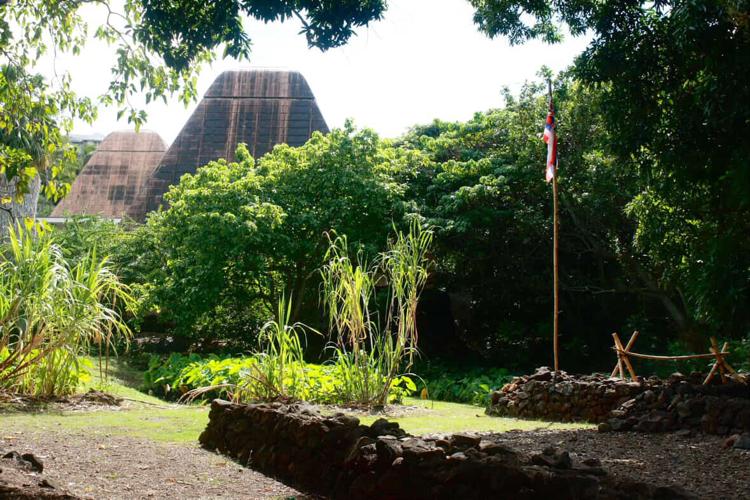

The sun hangs low over the misty Mānoa Valley, casting a golden glow across the paddies of Ka Papa Lo‘i ‘o Kānewai. Students and caretakers of this living classroom are planted knee-deep in the mud, their hands gently tracing the young taro shoots as water trickles steadily through the faithful ‘auwai, an irrigation ditch or canal used to bring water to the lo‘i.
The earthy scent of kalo leaves rises around them as they work the lo’i, a wetland taro patch, mingling with the warm air. Between the tugs of taro and careful planting, laughter and mo’olelo travel across the lo’i with the rhythm of their work. This ancient process feels like a conversation with the lo’i itself, and those who worked to pass down these traditions before us.
“I wanted to just get my hands dirty and give back to the community,” said Lahela Tuazon, a freshman journalism student and volunteer. “When we are here, we’re not just learning, we are remembering.”
This beautiful picture of togetherness and heritage could soon be under threat.
Across the country, the Trump administration proposed and enacted budget cuts at major federal agencies, rippling outward from Washington into places like Hawaiʻi. In the past year, the federal government has initiated sweeping reductions across science, education, and sustainability initiatives. The recent federal budget proposals for fiscal year 2026 have called for cuts to education and research programs that are entwined with university systems like UH Mānoa.
The White House’s proposed $163 billion reduction to nondefense discretionary spending includes major cuts to the Department of Education, the National Science Foundation (NSF), and the Environmental Protection Agency (EPA), according to The Washington Post.
Because UH Mānoa is a Research 1 (R1) institution, its operations and opportunities are deeply tied to federal research and education grants. These funds support everything from scientific discovery and environmental research to student development and cultural preservation. When federal agencies like the Department of Education, NSF, and EPA face major budget reductions, the impact trickles down, limiting grant availability, cutting student support services, and shrinking research partnerships that sustain programs across the university.
At UH Mānoa, the effects of those proposed federal cuts are already being felt. Wendy Hensel, who became president of the University of Hawaiʻi 10-campus system in 2024, has warned that reductions in federal funding could jeopardize programs central to the university’s mission as a “Hawaiian place of learning.”
In an announcement made on September 10, Hensel addressed the changes, revealing that the U.S. Department of Education declared it will end discretionary funding for several Minority-Serving Institution grant programs, including those for Alaska Native, Native Hawaiʻi, Asian American and Native American Pacific Islander Serving-Institutions because they tie eligibility to race/ethnicity quotas.
“This is a deeply concerning development raising important questions for all 10 campuses. It will affect all of our students, the programs that support them and the dedicated staff who carry out this work,” Hensel stated.
“Today’s announcement in no way diminishes the value or importance of that work.”
Rooted in the mission to advance Native Hawaiians at UH is the Hawaiʻinuiākea School of Hawaiian Knowledge. It is the first new college established at UH Mānoa since 1982 and the only college of Indigenous knowledge within a Research I university in the nation. Founded in 2007, Hawaiʻinuiākea brings together four key centers of learning: the Kamakakūokalani Center for Hawaiian Studies, the Kawaihuelani Center for Hawaiian Language, Native Hawaiian Student Services (NHSS), and the Ka Papa Lo‘i ʻo Kānewai Cultural Garden.
Each serves as a vital pillar of Hawaiian culture and education, bridging ancestral knowledge with contemporary research and student learning.
At the center of these efforts to preserve Native Hawaiian learning stands Willy Daniel Kauaʻi, originally working as a teacher at a nearby local charter school , and now the Director of Native Hawaiian Student Services.
“Hawai‘inuiākea is founded on the ideas that ʻIke Hawai‘i (knowledge, understanding, or wisdom gained through Hawaiian experience) and ʻŌlelo Hawai‘i (Hawaiian language) are foundational, that in ʻIke Hawai‘i and in ʻŌlelo Hawai‘i, are education, philosophies, and lifestyles of a people that lived here for millenia and a lot of those educational systems that were developed here in Hawaiʻi have tremendous application here today,” Kauaʻi said.
Kauaʻi first stepped into his role as Director of Native Hawaiian Student Services in 2014. Before this opportunity arose for him, he didn’t plan on taking on such an integral role at the Hawai‘inuiākea School of Hawaiian Knowledge. Trained as a teacher, he thought his work would stay in the classroom. Instead, he found himself managing the machinery that keeps programs for Native Hawaiian students at UH Mānoa alive.
“For me, it was a rather steep learning curve, but ultimately very exciting,” Kauaʻi said.
Kauaʻi describes his position as responsible for overseeing, managing, maintaining awards and grants in order to support student programming on our campus. At a more intimate level, Kauaʻi gets to see the development of students take place through his administrative work.
“UH Mānoa becomes that place for so many Hawaiians to learn more about who they are,” Kauaʻi said.
“Where else do we have these kinds of conversations but at the university? Where can we have these intellectual debates and battle each other using what we’ve learned in our respective disciplines? These are the things that make being a Hawaiian student exciting.”
Mānoa has historically seen an underrepresentation of Hawaiian students on this campus. Kauaʻi explained that NHSS was established in order to address these historical disparities of native Hawaiian students attending UH Mānoa.
“It is mission driven work. How are the historical barriers of our students preventing them from accessing higher education? How do we take that into account and create meaningful programming for them today,” Kauaʻi said.
“This mission is what keeps me motivated and excited about this work.”
Overseeing the broader objectives of the school is Dr. Jonathan Kay Kamakawiwo‘ole Osorio, the dean of the Hawai‘inuiākea School of Hawaiian Knowledge. A respected historian, musician, and advocate for Native Hawaiian sovereignty, Osorio has long emphasized the importance of protecting Hawaiian knowledge within Western institutions.
“The mission of HSHK is to perpetuate ancestral knowledge in all of its forms, to research it, to teach it, to publish it, to make it widely known,” Osorio said.
Osorio explained that the school began as a way of legitimizing the presence of native Hawaiians on this campus. Hawaiian studies went from simply being a kind of recruitment for bringing Hawaiians into the academy to training for political activism and an advocacy for what were at that point, emerging Hawaiian complaints against the society.
“Some of those complaints were nested in economic disposition, and political powerlessness, the prostitution of our culture to support tourism, etc,” Osorio said.
“The early Hawaiian courses generated a kind of attention and critique of what the state of Hawaiʻi was essentially doing to Hawaiians. Then at the same time, it began to build up into an insistence on the restoration of Hawaiian self rule.”
Movements and activism are very much a part of the student experience here at UH Mānoa, particularly part of the Hawaiian student experience whose education has always been intertwined with movements for representation and cultural recognition.
“In order for Hawai‘inuiākea to even have been here in the first place, it’s because of the protests and struggles of faculty and students to carve out a niche for Hawaiians and Hawaiian knowledge on our campus,” Kauaʻi said.
“Through a lot of fight, struggle, and activism by Hawaiian language teachers, Hawaiian Studies faculty, and students, they worked to convince the university administration that ʻike Hawaiʻi and ʻōlelo Hawaiʻi are valuable knowledge systems that deserve a rightful place in higher education.”
Kauaʻi highlighted the truth behind the progress that came with the consolidation of HSHK, noting that when you take classes that use ʻIke Hawai‘i and ʻŌlelo Hawai‘i as the cornerstone of teaching, you slowly come to realize that that struggle never really ended, and it continues.
“Even though HSHK is now on our campus, that doesn't mean Hawaiian issues have been resolved,” Kauaʻi said.
“In fact, it is almost the opposite.”
Although the lo‘i itself is not federally funded, programs like it and many other opportunities are accessed through the Native Hawaiian Student Services office. They now stand in a fragile position moving forward due to the budget cuts. While NHSS does not directly operate Ka Papa Lo‘i ʻo Kānewai, NHSS actively partners with the lo’i in a number of ways, including regularly bringing students to connect classroom lessons with hands-on cultural practice through community workdays, Hawaiian language and studies courses, and events like Aloha ʻĀina Days. Through these collaborations, students engage directly with the lo‘i, experiencing firsthand the lessons that Kānewai provides.
Nestled at the base of Waʻahila Ridge in Mānoa Valley, Ka Papa Loʻi ʻo Kānewai has long been a center of Hawaiian knowledge and sustenance. Once a thriving network of loʻi kalo and ʻauwai that carried water from the Mānoa Stream, the site eventually fell into disuse. In the 1980s, a group of Native Hawaiian students, guided by kūpuna and other members of the community, revived the loʻi through the project Hoʻokahe Wai Hoʻoulu ʻĀina.
“The students had reclaimed it, and in the process of reclaiming it, the university administration at the time found out and told them they had to stop because they were violating policy,” Osorio said.
“According to them, they had other plans for that land, and so the students protested, carrying the message that this site was a Hawaiian place.”
Eventually, the university relented, choosing to support the restoration of the lo‘i rather than resist it. What was once contested ground is now celebrated as a living testament to the campus’s mission to honor Hawaiian learning.
“The lo’i and the progress it brought would not exist if it weren’t for the people’s display of activism,” Osorio said.
Today, Ka Papa Lo‘i o Kānewai still brings to life the very principles that the Hawai‘inuiākea School of Hawaiian Knowledge seeks to impart on the students at UH Mānoa, grounding education in culture, community, and ʻāina.
Kauaʻi noted that the lo’i is visited more than almost any place on campus, and is where Hawaiian students are introduced to the university for the first time.
“It is a gathering place of all ages that is usually their first introduction to UH. And what better of an introduction to the campus than through a living lo’i?” Kauaʻi said.
Kauaʻi described Kānewai as a kind of homebase for Hawaiian students that come to UH who do not always see themselves reflected in the campus. For example, many of the buildings you come across on campus are named after certain white people instead of Hawaiian names.
“What is the psychology of a Hawaiian when they see and feel the kind of landscape that often seems foreign to them?” Kauaʻi said.
“It is difficult to succeed in an institution where you cannot see yourself.”
Ka Papa Lo‘i Kānewai became that anchor for so many Hawaiians. The ability to go and reflect in a place that is reminiscent of who that person is, is imperative to an indigenous person’s schooling.
Not only does Kānewai have a major impact on the Hawaiian demographic at UH, it is also a natural classroom and a living example of why ʻIke Hawai‘i is a valuable academic enterprise. Traditional Hawaiian agricultural and sustainability practices operate in harmony with the natural ecosystems here in Hawai’i.
Kauaʻi stated that being a restored lo’i with around 60-70 varieties of kalo, many of the different sciences use that lo’i to conduct their research.
“Through the eyes of our kupuna, they understood what sustainability was even without that label. It was something that they practiced, and if it was labeled, it would be something close to Aloha ʻĀina,” Kauaʻi said.
Educational innovation, especially during certain periods of time in Hawai‘i, means survival.
“How did people survive in one of the most isolated regions on the planet without reliance on outside imports? Within that are many of the answers to the problems we face today,” Kauaʻi said.
Out of the different schools in HSHK, NHSS alone has a primary focus on getting out opportunities for Hawaiian students through outreach to high schools, transfer cohorts, and community partnerships. NHSS operates two resource centers that provide academic, cultural, and wellness support for Native Hawaiian students at UH Mānoa. Services include advising, tutoring in math, writing, and ʻōlelo Hawaiʻi, and workshops on scholarships, technology, and career development. NHSS also coordinates internships and field schools.
Among the most concerning for Hawaiʻi are reductions to Title III programs, including the Strengthening Alaska Native- and Native Hawaiian-Serving Institutions grants, funds that the Department of Education now plans to phase out or consolidate. For NHSS, which relies almost entirely on Title III federal grants, these cuts could mean heavily diminished resources for students, less funding for community-based learning, and a direct threat to programs that bridge indigenous knowledge with academic research here on UH.
“I think there is zero understanding at the federal level of why indigenous knowledge matters, and I think anybody that had that kind of understanding has already lost their job,” Osorio said.
“There's no telling how much worse it could get, especially when the federal government is deciding to go after programs that seem to be, in its opinion, objectionable.”
Kauaʻi asserted that NHSS is almost 90% reliant on federal funding. The office has been receiving U.S. Department of Education Strengthening Institutions grants since 2008. The SIP program falls under Title III, Part A of the Higher Education Act. NHSS garnered close to $25 million in grants from this program.
“When Trump came into office, NHSS became more alert because of the other programs that were being defunded,” Kaua‘i said.
“The first gunshot that went off was aimed at DEI, so that gave us the indication that we would be on the chopping block too someday. There was already a lot of writing on the walls.”
By Oct. 1, 2026, those federal fundings will be terminated, giving NHSS a little under a year to wrap up the projects and programs they currently have as well as finding other sources of funding to supplement the programs that they offer.
“This is not just affecting our office, it is affecting a wide range of units across the university that also provide services to minorities,” Kauaʻi said.
Kaua‘i said NHSS has long warned the administration that this isn’t just an HSHK issue, it’s a university-wide one. Recently, President Hensel consolidated reserves from different schools to cover faculty salaries, a move Osorio said reflected how at risk every department is to federal cuts.
“In general, all programs at the university are vulnerable to the federal cuts. Many of the faculty, especially in some of the hard sciences and engineering and others who have been working as full time faculty, mostly doing research, anywhere from 25% to 75% of their salaries was paid for by federal grants,” Osorio said.
“They were an inescapable liability for UH because they were either under contract or they were tenured so they had to get paid.”
Kauaʻi took the budget cuts as an opportunity to revisit old conversations with the university and administration, given that one of the major strategic initiatives of the university is to become a Hawaiian place of learning and NHSS programs align with that goal.
“At times, offices such as ours are taken for granted,” Kaua’i said.
“There are entities on our campus that should be more aware of our programs, and even our philosophies as Hawaiians.”
For Kaua‘i, the loss of that funding isn’t just a bureaucratic setback, it’s a threat to something much deeper. UH Mānoa is now home to the largest concentration of Hawaiian students engaged in higher education, and that is largely because of NHSS. There are approximately 3,000 Hawaiian students attending UH Mānoa, 2,200 undergraduates and about 800 to850 graduate students, according to Kauaʻi.
“After 2026, if we don’t find any other funding, our office won't have any operation budget. The successful programming NHSS developed throughout its existence will go away. The kinds of gains that we have seen with regard to Hawaiian recruitment, retention, persistence, and graduation will also go away too,” Kauaʻi said.
“Trump took a sledgehammer to our office, and I don’t know if there’s much left to destroy.”
Growing up in Maui, Kauaʻi spent his teenage years at Maui High School. As a product of the public school system, Kauaʻi, as well as many other Hawaiian students, observed that public school education offers little meaningful connection to their own culture or history. Unfortunately, that is the opportunity that many young indigenous children are afforded.
“Given the marginalization of Hawaiian education and Hawaiian history in our public education system, you have generations of Hawaiians that many would argue were lost,” Kauaʻi said.
Over time, the Hawaiian language stopped being spoken at home, and traditional practices and customs faded from daily life, leaving many Hawaiians disconnected from their culture and unsure of their identity. Essentially, we have a people who found themselves in the dark.
“Hawai‘inuiākea, in many ways, was that beacon for Hawaiian students,” Kauaʻi said.
“It is what recovered the lost generations.”
However, with these looming budget cuts, the stride toward progress for HSHK and NHSS is becoming increasingly difficult. Kauaʻi warns that campus diversity is at risk, with the boost for minority students likely to decline. Currently, Hawaiians remain underrepresented relative to the overall UH population, while non-Hawaiians are disproportionately present. According to the UH Mānoa website, 82.3% of the student population is not Hawaiian.
“These are structural problems, so we have to investigate how it became a structural domination. But in many cases, the university does not want to have those difficult conversations,” Kauaʻi said.
“They will be forced to realize that the university has an identity crisis. How can it say it wants to be Hawaiian while at the same time living and being okay with non-Hawaiians being overly present here?”
Higher education creates accessibility to pathways that extend beyond the individual, benefiting families and future generations. Kauaʻi points out that when Hawaiians remain generally underrepresented at the university level, they are disproportionately present in other areas like construction, the service sector, the military, and prisons.
“When a population is given only one option, it is contributing to the destruction of people that don’t necessarily call Hawaiʻi home," Kauaʻi said.
“What's being built and who is it being built for? Is it being built for that Hawaiian construction worker? No it isn’t.”
Kauaʻi emphasized that the university cannot ignore the systemic inequities that persist on campus. He holds the UH administration accountable for not following through on their obligations, failing to fully institutionalize programs that have proven effective for Native Hawaiian students with the Title 3 grants despite decades of demonstrated success. He even went as far as to say the university itself should make it a point to set money aside for funding NHSS.
“We provide all the data the administration could possibly need to show how successful our programs are, they should actually be funding it anyway,” Kauaʻi said.
“Why is the federal government funding us from 5,000 miles away when the university itself won’t prioritize Hawaiian students? If serving the community is at the top of your priority list, then show that in your budget.”
Kauaʻi emphasizes that UH Mānoa must recognize the importance of Hawaiian knowledge and the role of Hawaiʻinuiākea, saying that it needs to be more outspoken. He cautions that the university’s efforts to become a “Hawaiian place of learning” often focus on appearances or symbolic projects, rather than addressing the real needs of the Hawaiian community at UH.
“It is simply easier to deal with than dealing with our historical disparity of students and faculty, but we have to be critical, to be sure that we are not working for and towards our own demise,” Kauaʻi said.
“At least the university gives you a critical lens to interpret that.”
Kauaʻi frames the legal and political challenges facing NHSS within a broader pattern of attacks on minority-serving institutions. He explains that these efforts are part of a coordinated push against them.
“Typically, they are white, right leaning people and organizations that bring these kinds of problems,” Kauaʻi said.
“They are using affirmative action laws, which were once put in place to protect minorities, but are now being used to go after them.”
To many, these budget cuts feel like a step back in time. As Kauaʻi put it, the struggle for Hawaiian development continues till this very day, and will continue for a long time.
Osorio understands the fear of the potential for these actions to open the doors to further oppression and racial discrimination, however, he does not think that Native Hawaiians, especially those engaged in Hawaiian studies, necessarily feel the same fear.
“And the reason is because we already know what it's like to be disparaged and dismissed,” Osorio said.
He explains that Hawaiian culture and language has been systematically suppressed under territorial governments, and the loss of heritage was intentional, not accidental. Having worked to reclaim and rebuild these aspects of Hawaiian culture, Osorio is confident that Hawaiians are prepared to defend them.
“If the white supremacists want to tangle with us, we’re ready for that fight.”


Comments